
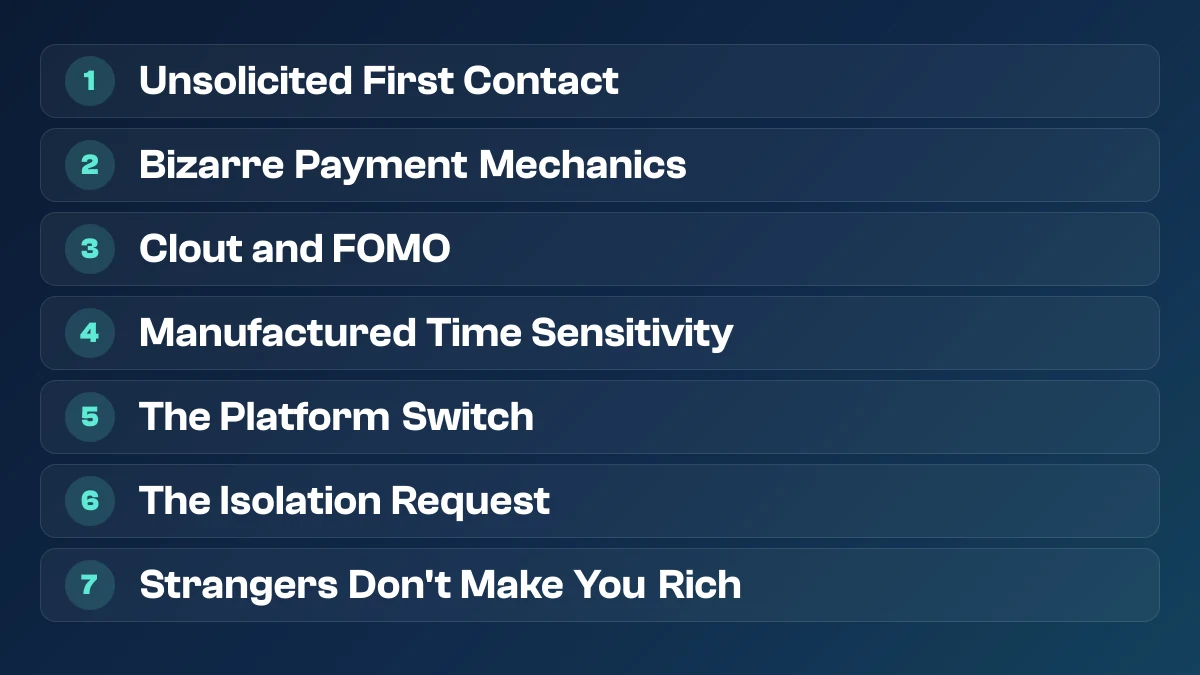
Every scam starts with its own story: an unexpected prize, a tax bill, a locked account, or an accidental message. The cover stories are endless, but underneath, the mechanics almost always rely on a handful of repeatable moves from the standard playbook.
Instead of trying to track every new scam variation, run any suspicious situation against these seven tests. If even one rings true, you have your answer.
Before any scheme can work, the scammer has to reach you. This could be a prize you never entered, a cold "customer service" call, a wrong-number text, or your "bank" alerting you to a suspicious charge.
Incoming caller ID and SMS cannot be trusted on face value. When in doubt, hang up and initiate contact yourself through an out-of-band channel: a phone number or portal found on an official card, statement, or trusted bookmark, never the one provided in the message.
The requested payment method is almost always a clearer signal than whatever story you're being told. Gift cards, wire transfers, crypto ATMs, cash deliveries, and peer-to-peer apps share one critical property: the transfers are effectively irreversible.
Scammers operate remotely and need irreversible extraction methods. No legitimate business, utility, or government agency will ever ask for payment via retail gift cards, cryptocurrency deposits, or cash drop-offs.
In Influence: Science and Practice, Robert Cialdini outlined the core psychological levers people respond to. Especially authority and scarcity.
Scammers lean heavily on these two:
- Impersonated Authority: Posing as law enforcement, tax officials, or bank fraud departments to force compliance through fear.
- Artificial Scarcity: Pitching exclusive access to high-yield investment pools or urgent "guaranteed" returns to bypass your critical thinking.
Ask yourself: Is this deadline driven by an external reality, or is it being manufactured by the person on the other end?
Urgency induces an elevated emotional state that degrades decision-making. A quick reality check is asking: "What actually happens if I wait until tomorrow to decide?" Legitimate institutions, banks, and courts do not operate on ten-minute deadlines. Taking a beat to verify never spoils a real transaction.
If a conversation begins on a moderated channel (an online marketplace, dating app, job board, or official support chat) and the other party quickly insists on moving to WhatsApp, Telegram, or Signal, that shift itself is the tell.
Moderated platforms have trust and safety teams, account reporting, and fraud detection. Moving to private, encrypted messaging removes those safeguards and isolates you before the financial or personal data request lands.
Any instruction to keep a situation secret, like warning you not to tell your family, bank teller, or local police is an immediate indicator of fraud.
Legitimate organizations never penalize you for consulting a third party or seeking independent advice. Scammers require secrecy because an emotionally uninvested outsider will spot the fraud instantly. If someone says "keep this between us," treat the secrecy request itself as the red flag.
Nobody who doesn't know you has a reason to offer you guaranteed investment returns, free money, or insider allocations. Not a stranger from a wrong-number text, not a recruiter for an unknown trading app, and not a surprise sweepstakes.
Ask the core question: What does this counterparty actually gain by making me wealthier? Real financial entities make money through transparent fee schedules and spreads, not pure generosity. If you cannot identify their economic incentive, the offer itself is the scam.
The Quick Rule: You do not need to memorize every specific scam pitch. Look for the underlying mechanics: unsolicited contact, irreversible payments, artificial panic, off-platform redirection, and requests for secrecy. The mechanics give it away every time.